



EOR vs company setup Thailand is not simply a cost comparison. You can hire in Thailand without setting up a company, but that does not mean an Employer of Record (EOR) is always the right answer.
The useful question is: does Thailand need to be a hiring footprint, or a commercial operating footprint for your business?
If you need to employ a small team while testing the market, an EOR can give you a practical starting point. If you need to sign local contracts, invoice customers from Thailand, hold assets, import goods, or build a long-term operation, setting up your own entity deserves an earlier conversation.
For many businesses, the answer is staged rather than permanent: start with an EOR, learn what the Thai operation actually requires, then move to an entity when the commitment is clear. At Simple Outsource, we usually see an entity become worth evaluating at around 10 or more employees, or when there is a clear long-term commitment. That is a planning threshold, not a legal rule.
Key Takeaways▾
- Use an EOR when Thailand is primarily a place to hire and you do not yet need your own local commercial vehicle.
- Evaluate company setup when the business needs to contract, invoice, trade, import, hold assets, or build a defined long-term operation in Thailand.
- The 10-plus-employee point is a practical reason to review the model, not a legal threshold or a universal cost break-even.
- A staged EOR-to-entity move can let you hire first and establish the company once the commercial case is clear.
EOR vs company setup Thailand: start with the business you need to run
Choose an Employer of Record in Thailand when your immediate need is to employ people locally. The EOR becomes the legal employer and handles employment contracts, payroll, tax, Social Security Fund administration, and employment compliance, while you manage the employee’s day-to-day work. Explore our Employer of Record services in Thailand.
Choose company setup in Thailand when Thailand needs to become part of how you conduct business, not only where your people sit. A Thai entity can be the right structure to support commercial activity, local invoicing, assets, contracts, and a longer-term operating presence. See what company registration in Thailand involves.
| Immediate need | Legal-employer and commercial setup | Best fit or consideration |
|---|---|---|
| Employ people locally while testing demand | An EOR is the legal employer; the overseas business directs day-to-day work | Usually evaluate EOR first |
| Hire before deciding whether Thailand will be a lasting market | The EOR handles employment administration while the wider strategy is tested | Usually evaluate EOR first |
| Add a Thai team to a business operated commercially elsewhere | The EOR provides the employment structure without creating a Thai entity for the client | Usually evaluate EOR first |
| Invoice locally, trade, hold assets, import, or contract through a Thai operation | Your own entity may be needed as the local commercial vehicle; activity and ownership need review | Evaluate company setup and structure |
| Build a defined, long-term Thailand operation | Your own entity becomes the local employer and operating structure | Evaluate company setup early |
| Employ people now while preparing for a future entity | Begin with EOR, then move employees when the entity is ready and appropriate | Build an EOR-to-entity transition plan |
There is no universal legal or cost break-even point. The right decision depends on what the business must do in Thailand, who will employ the team, and how committed the operation is likely to become.
What changes when you use an EOR instead of your own entity?
An EOR changes the employment structure, not your relationship with the work itself.
With an EOR, the provider is the employee’s legal employer in Thailand. The provider manages employment documentation, payroll, tax, Social Security Fund matters, and employment compliance. You still direct priorities, projects, performance expectations, reporting lines, and daily work. Employer of Record services in Thailand are designed for that division of responsibility.
With your own entity, your business becomes the local employer. That gives you a different foundation for operating locally, but it also means the company must be established and maintained for the role it will play.
An EOR is usually the better first move when Thailand is primarily a place to hire. An entity is usually the better conversation when Thailand must become a place to operate commercially.
Headcount alone cannot decide the issue. A local commercial operation that needs to contract and invoice in Thailand may need an entity discussion sooner than a delivery team working for an overseas business.
Start with what your business needs to do in Thailand
Before comparing service fees or incorporation steps, write down the activity you are actually planning.
- Will the Thai team work for an overseas company, or will the business need a local company to contract with customers or suppliers?
- Will you need to invoice from Thailand?
- Will the business hold local assets, lease premises, or import goods?
- Is the team a market test, a delivery team, or the beginning of a permanent country operation?
- Does the plan depend on foreign ownership, and could the intended activity require a specific permission?
- Are you hiring first and deciding on a broader Thailand strategy later?
The answers shape the structure review. They also reveal when an EOR is being asked to solve the wrong problem.
When EOR is a strong fit
EOR is often a sensible option when you have a real hiring need but an unfinished Thailand strategy. You may have identified your first employee, need a Bangkok-based team for a regional project, or see promising demand without knowing whether it will justify a permanent local operation.
An EOR lets you employ the team while the business tests the market and makes that larger decision with better information. Simple Outsource states that routine EOR onboarding normally takes 5–10 business days once required documents are available. Where work permits are needed, that process adds its own 4–8 week period. Read about our EOR process. These are service-process expectations, not a promise that every situation follows the same timeline.
When an entity is the better answer
An entity deserves serious evaluation when Thailand is no longer only a location for employees. If you need local commercial contracts, invoicing, assets, trading activity, or a durable operating base, company registration may better match the business you are building.
Company registration is not merely filing a name. A proper scope may include a structure review, Department of Business Development registration, tax identification number registration, possible VAT registration, Social Security registration when the first staff member is hired, and assistance with a corporate bank account. Learn about company registration in Thailand.
If your business already needs to operate commercially in Thailand, setting up an entity may be more appropriate than using an EOR, even if the EOR route looks easier at the beginning.
Foreign ownership can change the structure conversation

For foreign-owned or foreign-controlled operations, the activity and ownership structure need review before anyone assumes that ordinary company registration is enough.
Thailand’s Foreign Business Act defines a Thai-registered juristic person as “foreign” in certain circumstances, including where foreigners hold at least half of the capital or investment. The Act also provides that businesses listed under the legislation may require relevant permission, while treaty or government-permission treatment can affect how a case is considered. Foreign Business Act, Sections 4, 8 and 10.
The practical point is simple: foreign ownership and the business activity must be considered together. A foreign-majority company is not automatically impossible, nor does forming a Thai company automatically mean every activity is available without further review.
Thailand’s BOI One Stop Service Centre also notes that foreign ownership above 49% requires consideration of the Foreign Business Act lists and permission requirements. Its guidance is dated, so use it as context alongside the legislation itself. Read the BOI OSOS guidance.
The Act’s minimum-capital provisions say no less than THB 2 million for a foreign business generally and THB 3 million per restricted business where the Act applies. It also refers to a 60-day consideration period after an application in Section 17. Neither point is a universal cost or total project timeline. Foreign Business Act, Sections 14 and 17.
For more context, see our guide to the Foreign Business Act in Thailand.
A practical decision map: use the answer that fits today
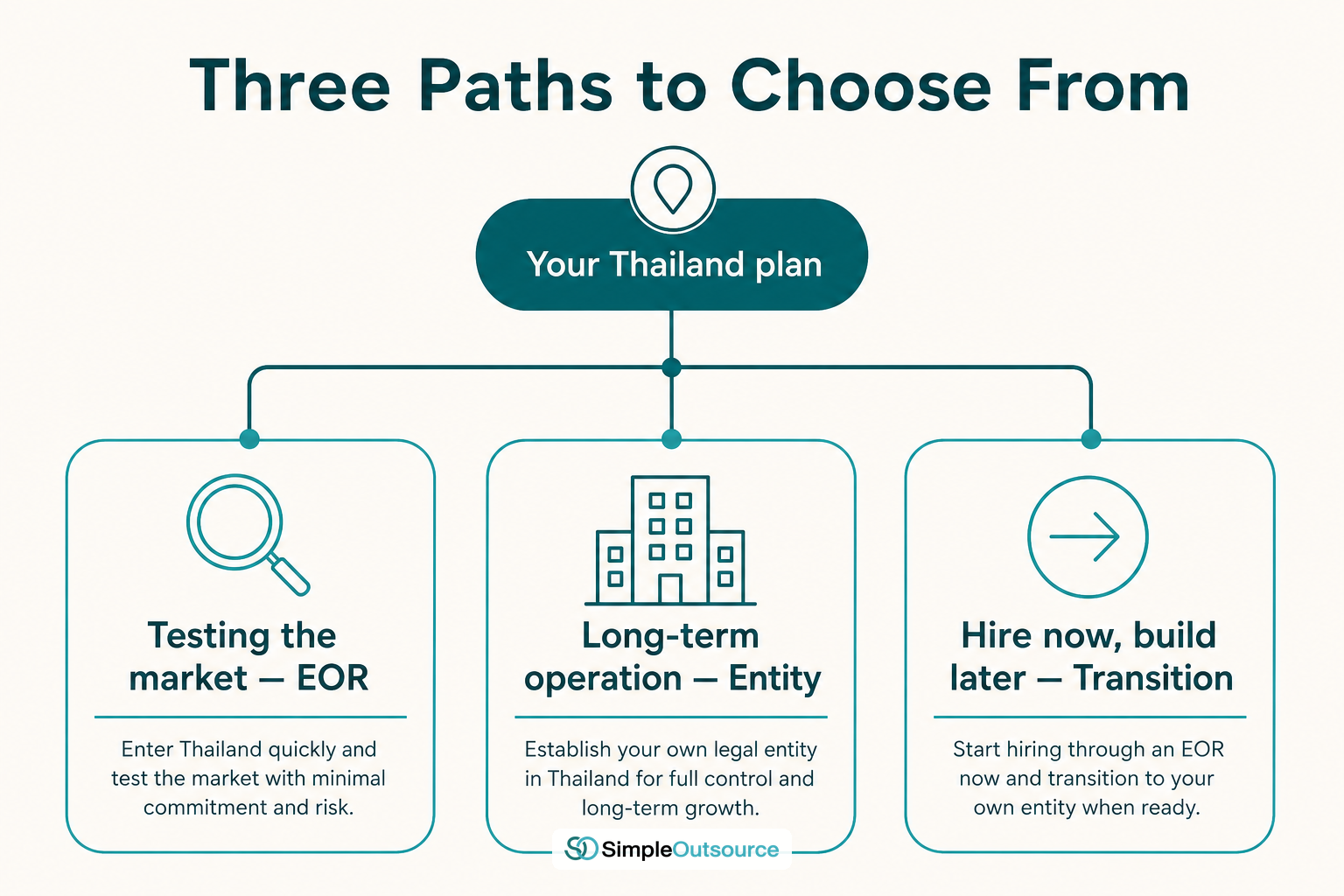
Path one: you need to hire, but you are still testing Thailand
Start with an EOR if the immediate objective is to place employees in Thailand and learn from the market. This works when the local team is small, the overseas company remains the commercial centre of the business, there is no current need for Thai invoicing or assets, and hiring is more immediate than the entity decision.
The EOR is not a shortcut around commercial-structure questions. It is a way to solve the employment question while those questions are still being answered.
Path two: you know Thailand will be a long-term operation
Move directly into an entity review if the business already has a settled plan for Thailand: a committed local market, a defined commercial activity, local contracts, or a team that will grow beyond an early-stage footprint.
In our experience, a business with typically 10 or more employees, or a clear long-term commitment, should assess whether its own entity is becoming more cost-effective. Employer of Record services in Thailand. This is a practical prompt, not law. A smaller team may need an entity sooner because of its activity, while a larger team may remain with an EOR when Thailand is still only an employment location.
Path three: you need to hire now and build later
Use an EOR to employ the first team. Keep the business model under review. Once the commercial purpose, headcount, and long-term commitment are clear, complete a structure review and establish an entity if it is the right next step.
How an EOR-to-entity transition can work
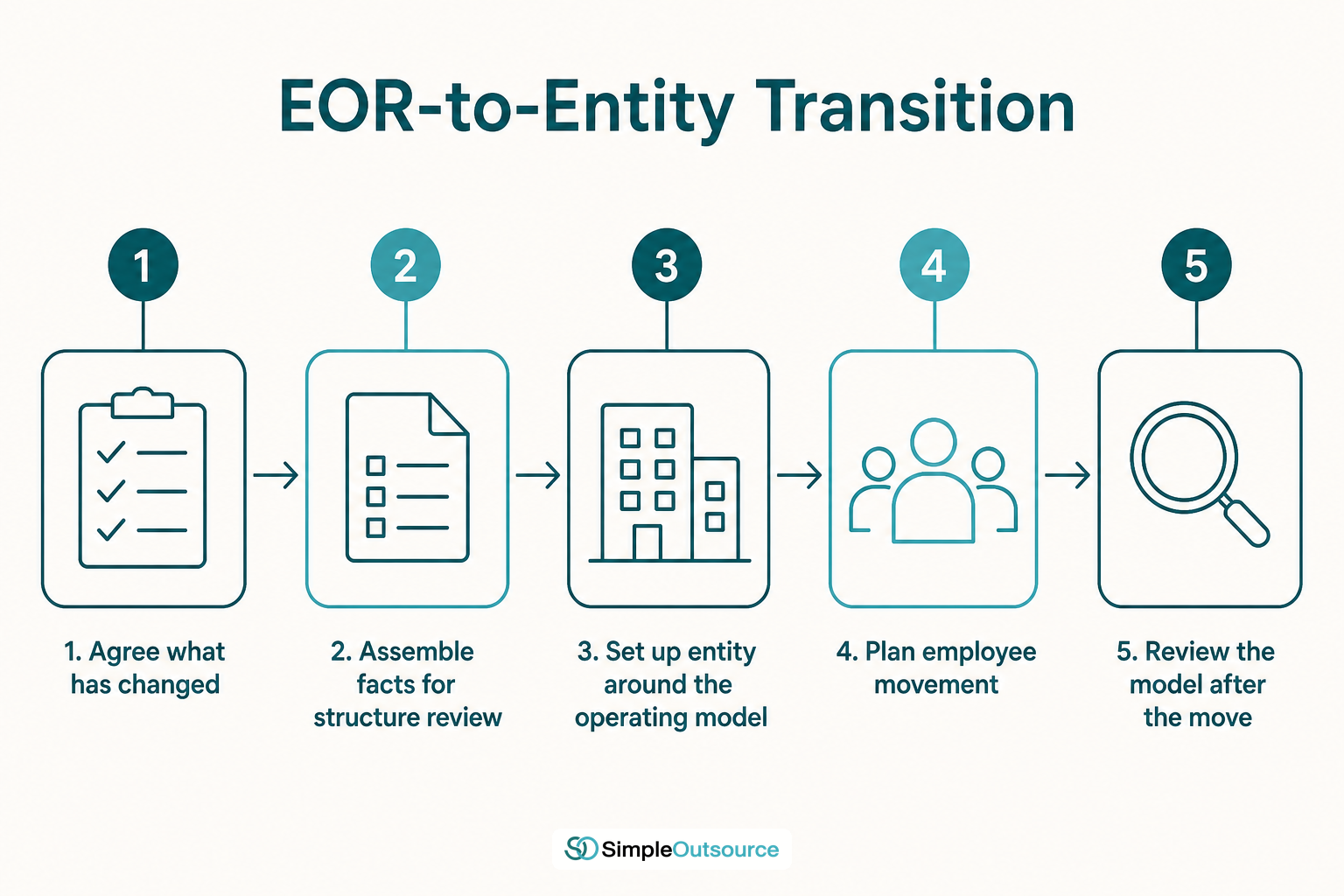
A future entity does not mean the EOR decision was temporary in a bad sense. It can mean the EOR did its job.
One European software business used Simple Outsource to employ five people in Bangkok. The team was onboarded in 18 days. Nine months later, once the business chose to establish its own entity, the employees moved across without disruption. This is a Simple Outsource client case, not an independent benchmark, but it shows the staged path in practice. Employer of Record services in Thailand.
The transition should be planned, not improvised:
- Agree what has changed. Identify the reason for moving: commercial activity, a growing team, a long-term country plan, or a structure that better fits the business.
- Assemble facts for a structure review. List the Thai activities, local contracting or asset needs, expected roles, ownership and capital intentions, foreign ownership, work-permit needs, and timing.
- Set up the entity around the operating model. Align incorporation with the business the company will actually run, rather than treating registration as an isolated administrative task.
- Plan employee movement before announcing it. Employees need clarity about their employer, paperwork, and what stays the same in their day-to-day work.
- Review the model after the move. Payroll, employment compliance, visas, work permits, tax, and reporting all need ongoing attention.
If you already have an entity but want help with the employment side, the question may be EOR vs PEO in Thailand, rather than EOR versus company setup.
Why cost comparisons alone give the wrong answer
The internet makes this decision look like a spreadsheet exercise. It is not.
An EOR involves an ongoing service relationship. An entity has formation work and an ongoing local presence. Those facts matter, but a headline comparison cannot tell you whether an entity supports the activity you need to conduct.
There is no universal EOR-versus-entity break-even. The useful break-even is strategic: when does Thailand stop being a hiring location and become a business operation you need to own?
Use cost as part of the decision. Do not let it replace the decision.
Questions to settle before choosing a path
- What will the Thai team do, and for which company?
- Does the business need a Thai entity to contract, invoice, trade, import, or hold assets?
- Is Thailand a market test, a regional support base, or a long-term commercial operation?
- How many people do you expect to employ after the initial hiring period?
- Is foreign ownership planned, and does the intended activity require a Foreign Business Act review?
- Do any roles involve work permits?
- What would trigger a move from EOR to an entity: headcount, revenue activity, local contracts, or a defined country commitment?
Talk through the structure before you commit

If you are hiring your first people in Thailand, our Employer of Record services in Thailand can be a practical way to begin. If you already know the business needs a local operating vehicle, explore company registration in Thailand.
We can help map the employment need, commercial activity, and likely next step. The aim is not to push every business towards an entity or an EOR. It is to help you choose the structure that fits what you are actually building.