



Employer of record cost in Thailand is not one fixed number. A useful proposal separates the provider’s service fee from the employment costs attached to each hire, then makes clear which work sits inside the agreed scope.
That distinction matters because a low headline price can answer only one question: what the provider charges to administer the arrangement. It does not, by itself, show the full cost of employing a person in Thailand.
Key Takeaways▾
- Employer of record cost has layers: the EOR service fee, employee compensation, employer obligations, benefits, and any relevant immigration support.
- A public starting price is a provider’s model, not a complete Thailand employment budget.
- Headcount, pay structure, employee status, benefits, payroll cycle, and requested scope can change a proposal.
- Ask providers to state implementation, deposits, foreign-exchange handling, offboarding, and add-ons before comparing quotes.
- Simple Outsource does not publish a fixed EOR rate because scope depends on the hiring situation. Explore our EOR service.
Why is employer of record cost more than a service fee?
Employer of record cost has two meanings that are often blended together. The first is the EOR provider’s fee. The second is the wider cost of employing a person: salary, applicable employer obligations, benefits, and work-permit or visa support where relevant. A quote is easier to compare when those layers are shown separately.
The service fee pays for the operating work the EOR agrees to handle. Depending on scope, that can include employment contracts, payroll administration, tax and social-security administration, compliance support, and employee support. It is not a substitute for the employee’s compensation or every cost connected to employing them.
What should a Thailand EOR proposal separate?
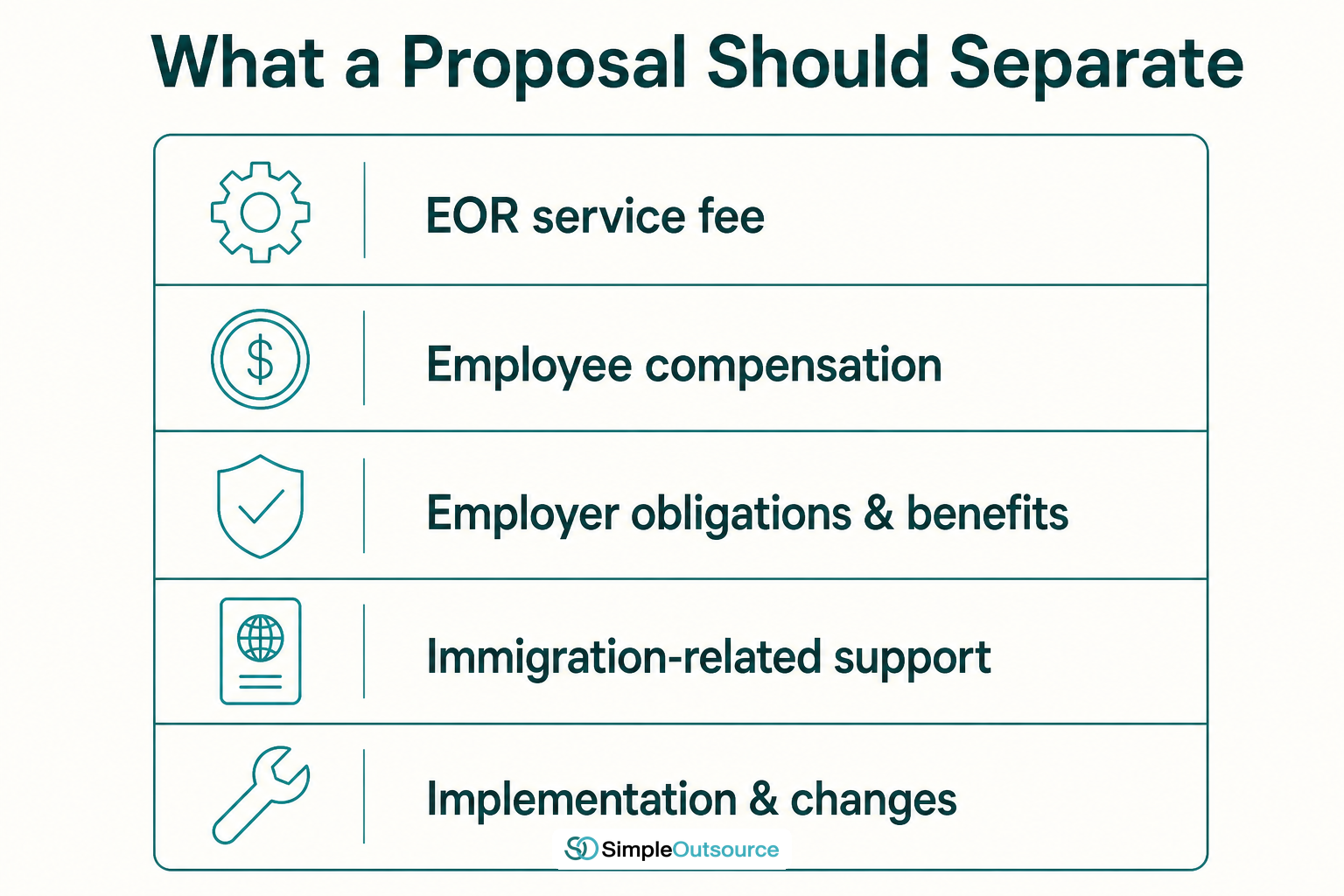
Ask the provider to separate the following categories.
The EOR service fee. The scope should say whether it covers contracts, payroll, tax administration, social-security administration, compliance support, employee queries, and other agreed work.
Employee compensation. Salary and other agreed compensation belong to the employment cost, not the EOR’s service fee. Where pay has several components, ask for each to be shown clearly.
Employer obligations and benefits. A proposal should let finance and HR understand what is employer-funded, employee-related, and requested as a benefit. Benefits administration does not necessarily mean the provider is paying for the benefits.
Immigration-related support. A local and an expatriate hire may not need the same work. If a visa or work permit is relevant, ask how it is handled, what is in scope, and which items need separate confirmation.
Implementation and changes. Initial setup differs from monthly administration. Discuss contract changes, onboarding, offboarding, and termination-related processes before they become urgent.
Which details change EOR pricing in Thailand?
Pricing changes with the work required to employ and support the person, not simply the job title. Tell providers the planned headcount and likely changes, the pay structure and payroll cycle, whether each person is a local or expatriate hire, and whether immigration support is needed.
Benefits, contract requirements, onboarding needs, and likely changes after employment begins also need their own conversation. A useful quote begins with a plain-language scope: contracts, payroll, tax and social-security administration, compliance support, immigration coordination, and ongoing employee support.
Do public EOR prices tell you what Thailand will cost?

Public prices can be a useful starting point, but they are not a Thailand-specific employment budget. Columbus lists EOR services starting at $179 per month and describes contracts, payroll, benefits, tax filings, and support as included in that stated service. This is a provider’s published starting price and model, not a Simple Outsource price or a complete cost for every Thailand hiring situation.
Deel’s pricing page says quoted pricing includes local compliance, payroll, and benefits administration without turning that into one universal public amount. Gloroots states that its pricing is flexible based on hiring needs. Compare public starting prices in one column and the actual proposal scope in another: a figure is comparable only when the work behind it is comparable too.
What should you ask before accepting an EOR quote?
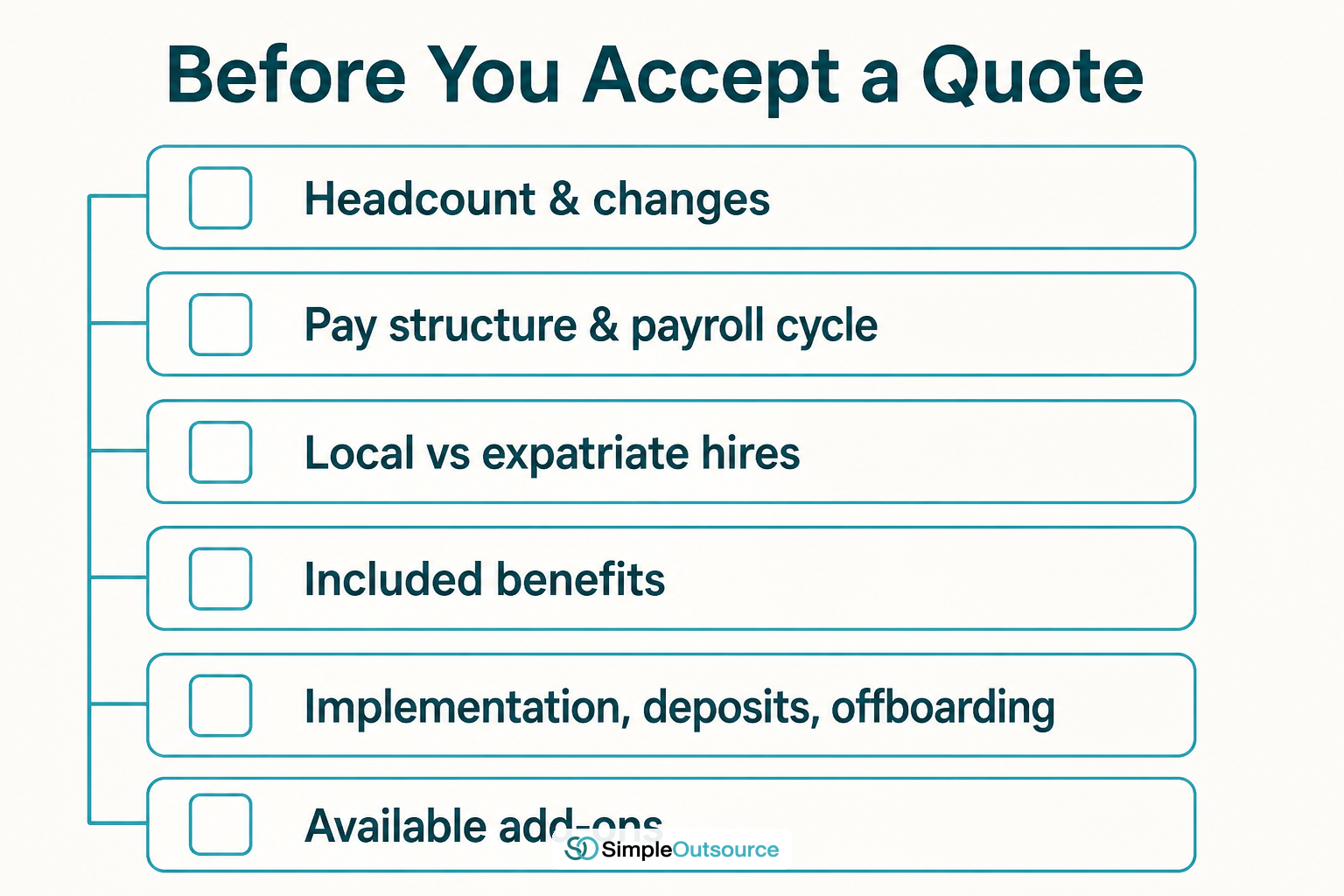
- How many employees does this cover, and what happens if headcount changes?
- How will our pay structure and payroll cycle be handled?
- Does it distinguish local hires from expatriate hires requiring work-permit or visa support?
- Which benefits are included, and which are administered separately?
- What is included in implementation, deposits, foreign exchange where relevant, offboarding, and termination-related support?
- Which add-ons are possible, and when would they apply?
These questions are the difference between comparing two labels and comparing two operating arrangements.
When is another route a better fit than an EOR?
An EOR is not automatically right for every Thailand hiring plan. If you expect to build a larger, long-term local operation and take on direct employment through your own entity, EOR versus company setup in Thailand may be the more useful decision. If you already have a Thai entity and need HR support, read EOR vs PEO in Thailand.
How Simple Outsource approaches EOR cost discussions

Simple Outsource does not publish a fixed EOR rate. Scope can depend on headcount, compensation, and whether work permits are involved. Our EOR service can cover employment contracts, payroll, tax, social security, compliance, and visa or work-permit support within the agreed arrangement.
Start by listing the employees you plan to hire, their pay structure, whether immigration support is relevant, and the HR and payroll work you want covered. Then talk through the scope with our EOR team and ask for a proposal that separates each cost layer clearly.