



Written and reviewed by the Simple Outsource team — Thailand-based professionals handling company compliance, visas and work permits for foreign employers. Last updated: August 2026.
A one-year Thailand work permit costs 3,100 THB in government fees: a 100 THB application fee plus a 3,000 THB permit fee, per the Ministry of Labour fee schedule. That figure is correct, it’s public, and it’s quoted almost everywhere.
It’s also the smallest line item in what your company will actually spend.
Some costs sit on an invoice — medical exam, translation, professional fees. Others never appear on one at all, because they’re conditions your company has to satisfy before an application is accepted. So the useful question isn’t “what’s the fee?” It’s “which of these do we already cover, and which is new money?”
Key Takeaways▾
- The Ministry of Labour charges 100 THB per application plus a duration-based permit fee, making 3,100 THB the standard government cost for a twelve-month permit.
- Preparation costs sit outside that fee: a work-permit medical certificate runs around 500 THB at clinics such as WellMed Bangkok Clinic, and certified Thai–English translation is priced per page (450–650 THB at First Choice Translation).
- The Board of Investment’s published cost guide puts law firm or agency handling of the combined visa and work permit process at 30,000–35,000 THB, with processing cited at 1–10 days.
- The largest cost isn’t a work permit fee at all — it sits one step earlier, in qualifying to sponsor the Non-Immigrant B visa the permit depends on: generally 2 million THB of registered capital per foreign employee for Thai-majority-owned companies (3 million THB for foreign-majority-owned companies), plus four Thai employees for every foreign one.
- BOI-promoted companies pay the same government fees; what changes is the processing route and parts of the quota requirement, not the fee amount.
What does the government actually charge?
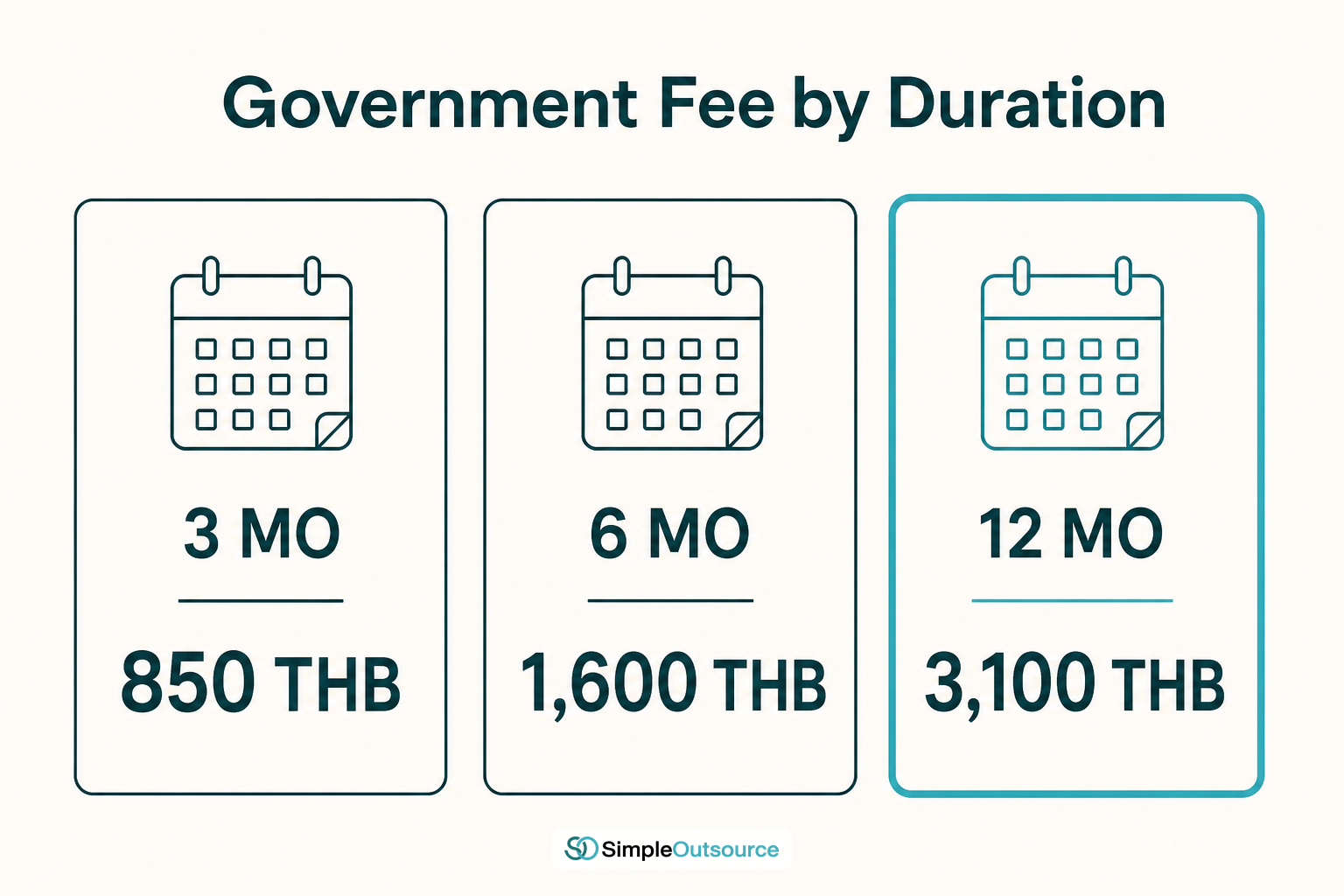
The Ministry of Labour publishes a fixed fee schedule, priced by how long the permit runs. Foreign professionals and managers fall under the “other professions” category, which is priced separately from the lower tier used for domestic workers and labourers.
| Permit duration | Permit fee | Application fee | Total |
|---|---|---|---|
| Up to 3 months | 750 THB | 100 THB | 850 THB |
| Over 3 up to 6 months | 1,500 THB | 100 THB | 1,600 THB |
| Over 6 up to 12 months | 3,000 THB | 100 THB | 3,100 THB |
Source: Ministry of Labour fee schedule (“อัตราค่าธรรมเนียม”).
Renewals follow the same duration-based tiers as new applications, so another twelve months carries the same 3,000 THB permit fee. Changes during the permit’s life are priced separately by the Ministry of Labour: 500 THB for a replacement permit, 1,000 THB to change or add a job description, 1,000 THB for a work location, 150 THB for conditions — and 3,000 THB to change or add an employer, the same as issuing a fresh twelve-month permit.
The Board of Investment’s Cost of Doing Business in Thailand guide lists the same 750 / 1,500 / 3,000 THB figures. This part of your budget isn’t where the uncertainty lives.
The costs that come before you reach the labour office

Two preparation costs apply to essentially every application, and neither is set by the government.
The first is the medical certificate. WellMed Bangkok Clinic publishes a rate of 500 THB for the work-permit medical certificate, covering the examination and a syphilis blood test, issued the same day. It isn’t a government-fixed price, so it varies between providers.
The second is document translation, and it’s the one that surprises people, because it’s priced per page rather than per application. First Choice Translation publishes certified Thai–English rates of 450–650 THB per page. A realistic set — passport, degree certificates, employer letters — usually runs to several pages, so this line lands in the low thousands of baht, not the hundreds. Be sceptical of any provider quoting a fixed translation total before seeing the file.
The biggest cost isn’t a fee at all — it’s the threshold you have to clear first
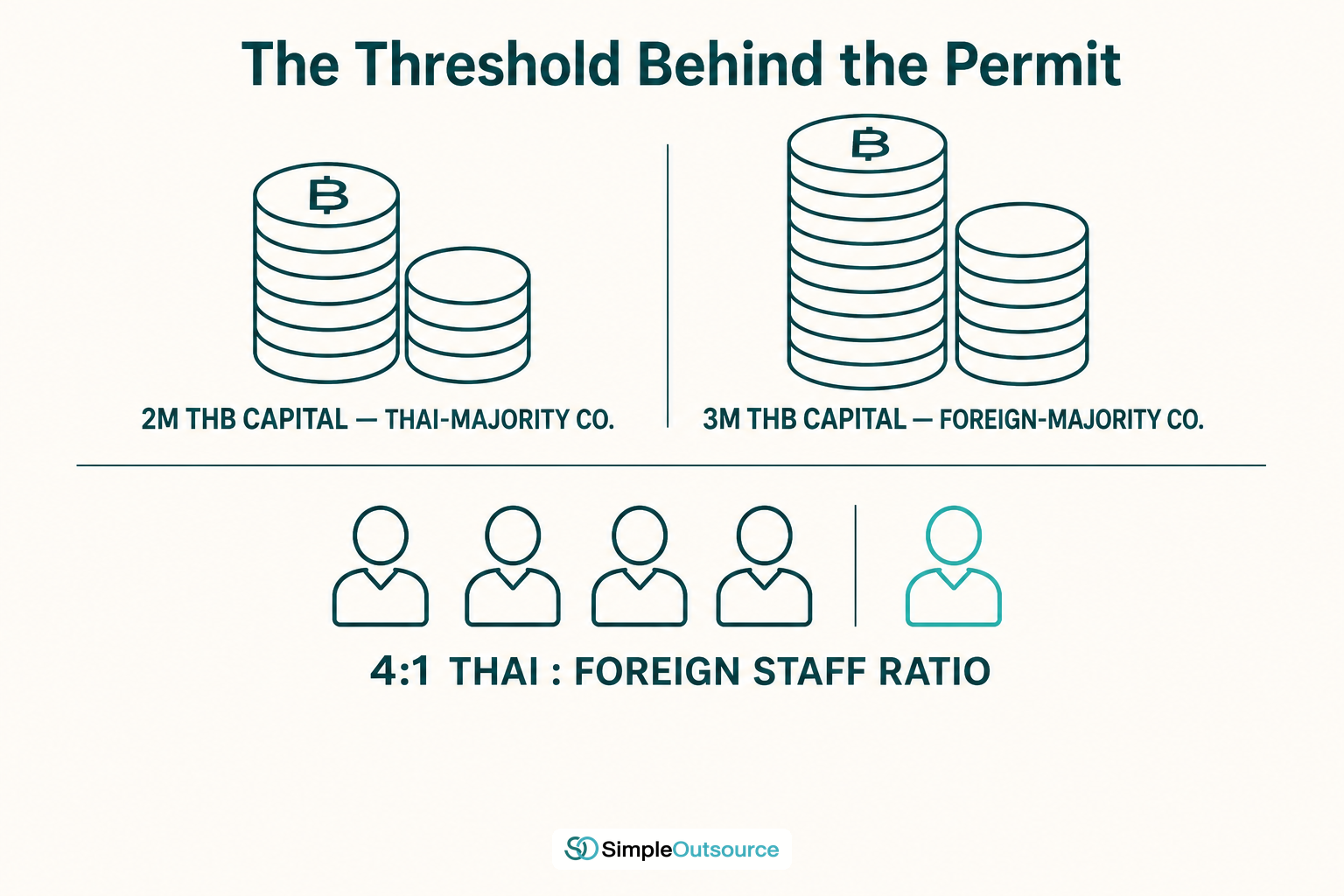
A work permit rests on a Non-Immigrant B visa, and it’s qualifying to sponsor that visa — not the permit itself — that carries the heavy conditions. In our work handling these applications for foreign employers, two decide most cases: registered capital of 2 million THB per foreign employee for Thai-majority-owned companies (3 million THB for foreign-majority-owned companies), and the ratio rule, under which a company generally needs four Thai national employees for every one foreign employee it sponsors. Some industries and BOI-promoted companies are exempt from parts of the standard quota requirement.
Neither of those is a fee. Registered capital isn’t spent, and Thai staff are people you presumably wanted to hire anyway. But if you don’t have them yet, four salaries and a capitalised entity dwarf every invoice above.
This is also where the honest answer for some companies is “not yet.” Setting up a Thai entity purely to sponsor one hire means capitalising a company and hiring four local staff to support one person. Sponsoring that person through an Employer of Record in Thailand instead moves the capital and headcount requirement onto an entity that already meets it. That isn’t right for everyone — if you’re building a real team here, you’ll want your own entity — but for one or two hires it changes the maths entirely.
Is an agency worth 30,000 THB when the fee is 3,100 THB?

Sometimes. It depends on whether anyone in your company has the time and the Thai-language capacity to run the file.
The Board of Investment’s cost guide puts the market rate at 30,000–35,000 THB for a law firm or agency to handle the visa and work permit process, with processing cited at 1–10 days. That looks like ten times the permit fee, but the two numbers aren’t describing the same job. The BOI range prices the whole sequence, visa sponsorship and permit together; the 3,100 THB is one filing inside it.
Handling it in-house is genuinely the better call when you’re filing one permit, the document set is simple, and you have a Thai-speaking staff member with time to spend at the labour office. It stops being the better call when the file has complications — a corrected company document, a qualification that needs verifying, an employer change mid-year — and that’s where paid expertise usually earns its fee. For what the work actually involves before you decide, see how to get a work permit in Thailand .
Our own visa and work permit service starts at 7,000 THB per person per year. It’s a starting price, not a flat one — what sits above it depends on how many people you’re filing for and how complicated each file turns out to be — but it’s a real number you can put in a budget before you speak to anyone, and we put the final scope in writing before anything starts.
How to build your own number
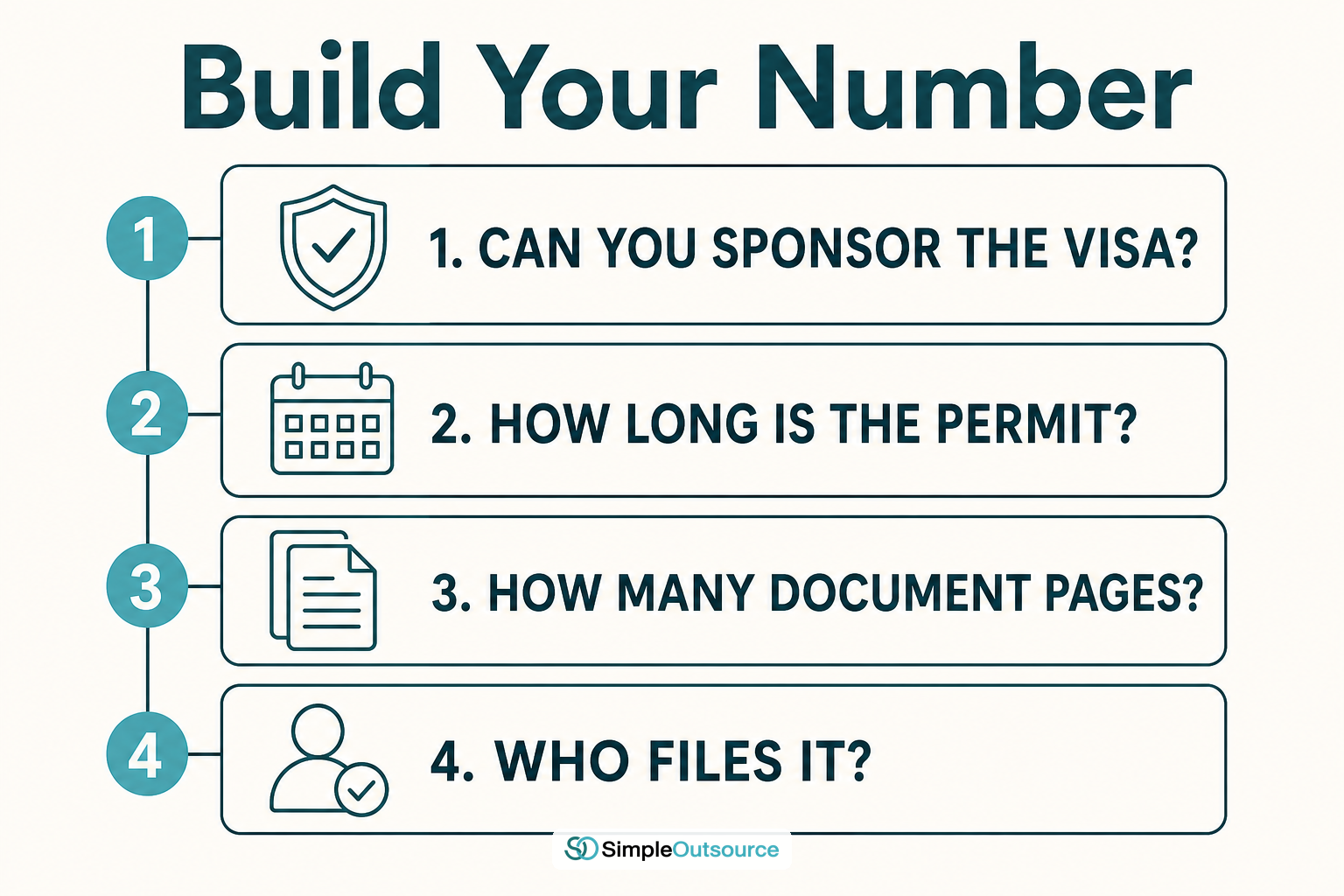
Take your situation through four questions, in this order:
- Can we qualify to sponsor the visa? The capital and Thai-staff requirements attach to the Non-Immigrant B sponsorship, not the permit fee. If you don’t meet them, that gap is your dominant cost until you close it or sponsor through an Employer of Record.
- How long a permit are we applying for? Twelve months puts you at 3,100 THB with the Ministry of Labour; shorter assignments cost less.
- How many pages is this candidate’s document set? Multiply by a per-page translation rate, then add roughly 500 THB for the medical certificate.
- Who is actually going to do this work? If the answer is “nobody has time,” add professional fees, and budget for them now rather than discovering them in month two.
Most companies that get burned on work permit costs didn’t underestimate the fee. They budgeted for the paperwork and got surprised by the threshold sitting underneath it.
FAQ
Before you commit to a number
The most useful thing you can do this week isn’t collecting quotes. It’s checking your registered capital and your current Thai headcount against the requirements above — because that one check tells you whether you’re looking at a few thousand baht or a structural decision about how you enter Thailand at all.
If you’d like someone to look at your specific situation, Simple Outsource’s visa and work permit service starts with a free consultation and a written quote. And if the answer is that you don’t need us yet, we’ll tell you that instead.