



The work permit is approved. Your new country manager can legally start on Monday, and you finally close the file. Then they ask the question that was never on your checklist: what happens to my wife and my two children?
Most employers discover the same uncomfortable thing at that moment. The Non-O visa Thailand requirements for accompanying family members are only half about the family. The other half is paperwork that can only come out of your office. If nobody in your company owns that step, the spouse and children sit on tourist entries while the employee starts work.
This article covers the Non-Immigrant O (Dependent) Visa for the family of an employee your company sponsors. It is written for the employer, not for the applicant.
Key Takeaways▾
- A Non-Immigrant O (Dependent) Visa covers a legally married spouse and children, adopted children or step-children under 20 who are unmarried and living with the visa holder, according to the Royal Thai Embassy in Phnom Penh.
- Two documents in the family’s application can only be issued by the sponsoring company: a copy of the employee’s work permit and an employer letter confirming position and salary (ThaiLawOnline, Superagent).
- The visa is first issued as a single-entry 90-day visa by a Thai embassy or consulate abroad, then extended in Thailand one year at a time using form TM.7 at 1,900 baht per person per year (ThaiLawOnline, Superagent).
- A dependent visa gives the right to stay, not the right to work. Any family member who wants a job needs their own Non-Immigrant B visa and work permit (Royal Thai Embassy, Phnom Penh).
Non-O visa Thailand requirements: who in the family actually qualifies as a dependent?
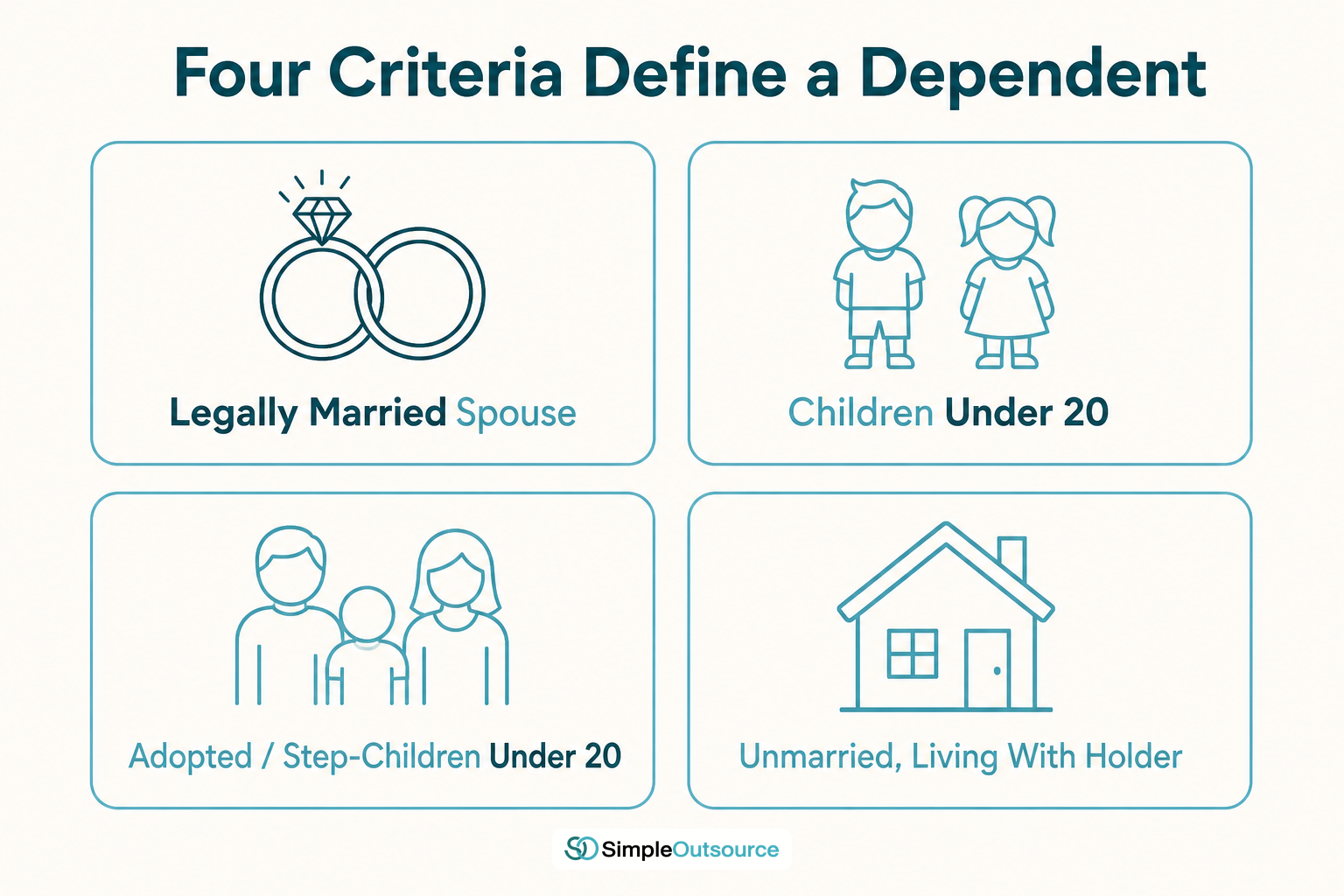
A Non-Immigrant O (Dependent) Visa is the visa category for the family members of a foreign national who holds a Non-Immigrant B visa and a Thai work permit. It covers a legally married spouse, and children, adopted children or step-children who are under 20 years old, unmarried, and living with the visa holder (Royal Thai Embassy, Phnom Penh). The Royal Thai Embassy in Yangon publishes the same criteria.
Two words in that list do a lot of work: legally married. A long-term partner without a registered marriage is not a dependent, however long the relationship has lasted. Neither is a 21-year-old the employee still supports.
That is worth knowing at the offer stage rather than in February, when the family is already packing.
The two documents only your company can issue

Every guide to dependent visas mentions “a letter from the employer” in passing. Almost none say what your company is actually being asked for.
The family’s application pairs their own civil documents with proof that the employee behind them is legitimately employed in Thailand. From the family: passports, the marriage certificate or birth certificates legalised for use in Thailand, and photographs. From you: a copy of the employee’s work permit, and a letter confirming their position and salary (ThaiLawOnline, Superagent).
The order is what catches companies out. A copy of the work permit cannot exist until the permit itself has been issued, so the family’s file is downstream of the full work permit process for the employee. Treat it as the last stage of the same project, not as a separate request that lands three weeks later when whoever prepared the original document set has moved on.
The financial test is about the sponsor, not the family
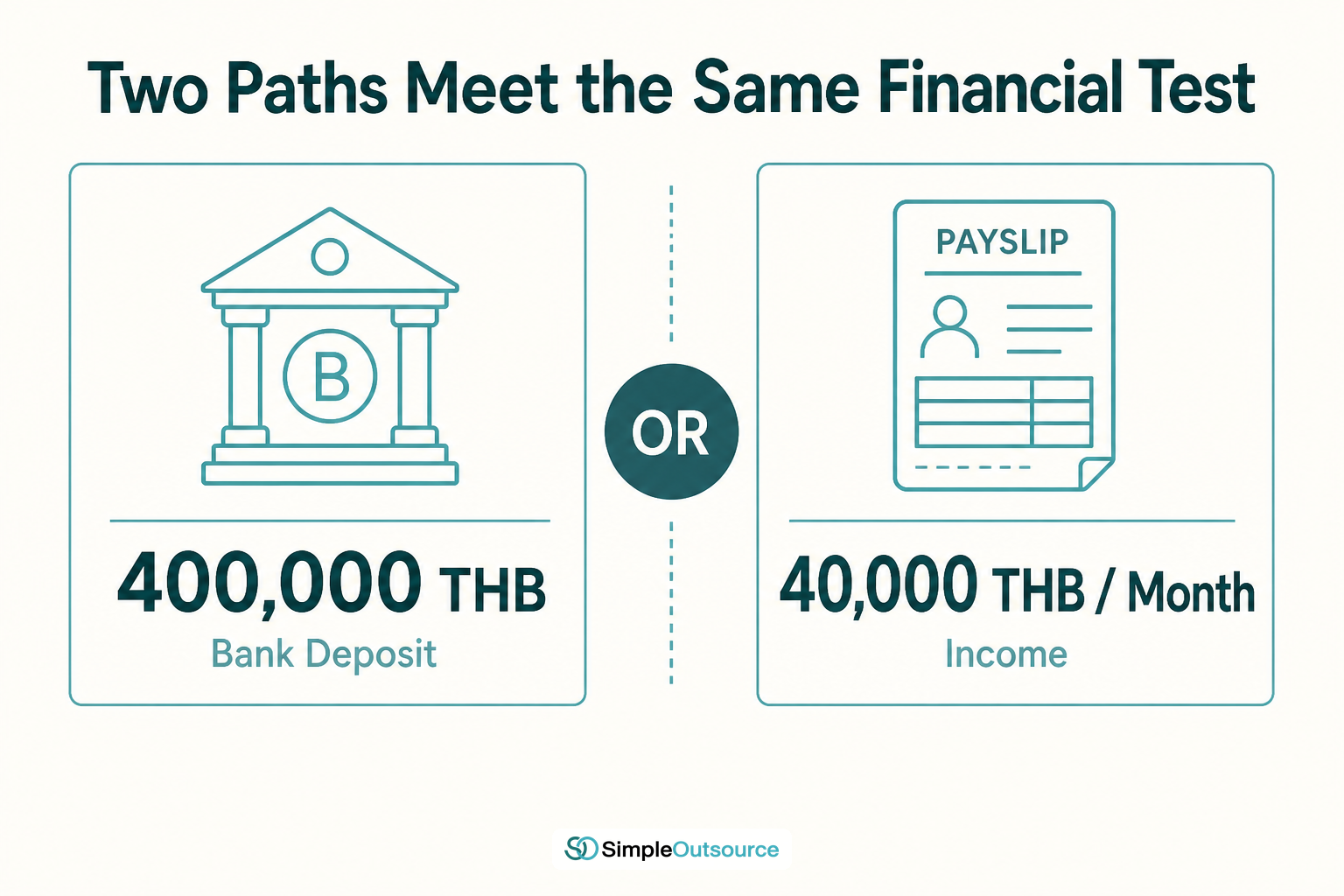
Dependents also have to show financial support behind the stay: either a deposit of at least 400,000 baht in a Thai bank account, maintained for the period the regulations require before the application, or income of at least 40,000 baht per month on the sponsor’s side (ThaiLawOnline, which sets this out under the framework of the Immigration Act B.E. 2522 (1979)).
For a company sponsoring a senior hire, this is usually a documentation question rather than a real hurdle. What matters is that the figure on your employer letter, the employment contract and the bank statements tell the same story.
Where it does bite is packages built around allowances, offshore payroll, or a low local salary with the rest paid elsewhere. If the Thailand-side salary on paper sits below the level being relied on, someone will have to explain the gap. Better to design the package with that in mind than to rewrite it later.
How long the visa lasts, and what happens every year after that
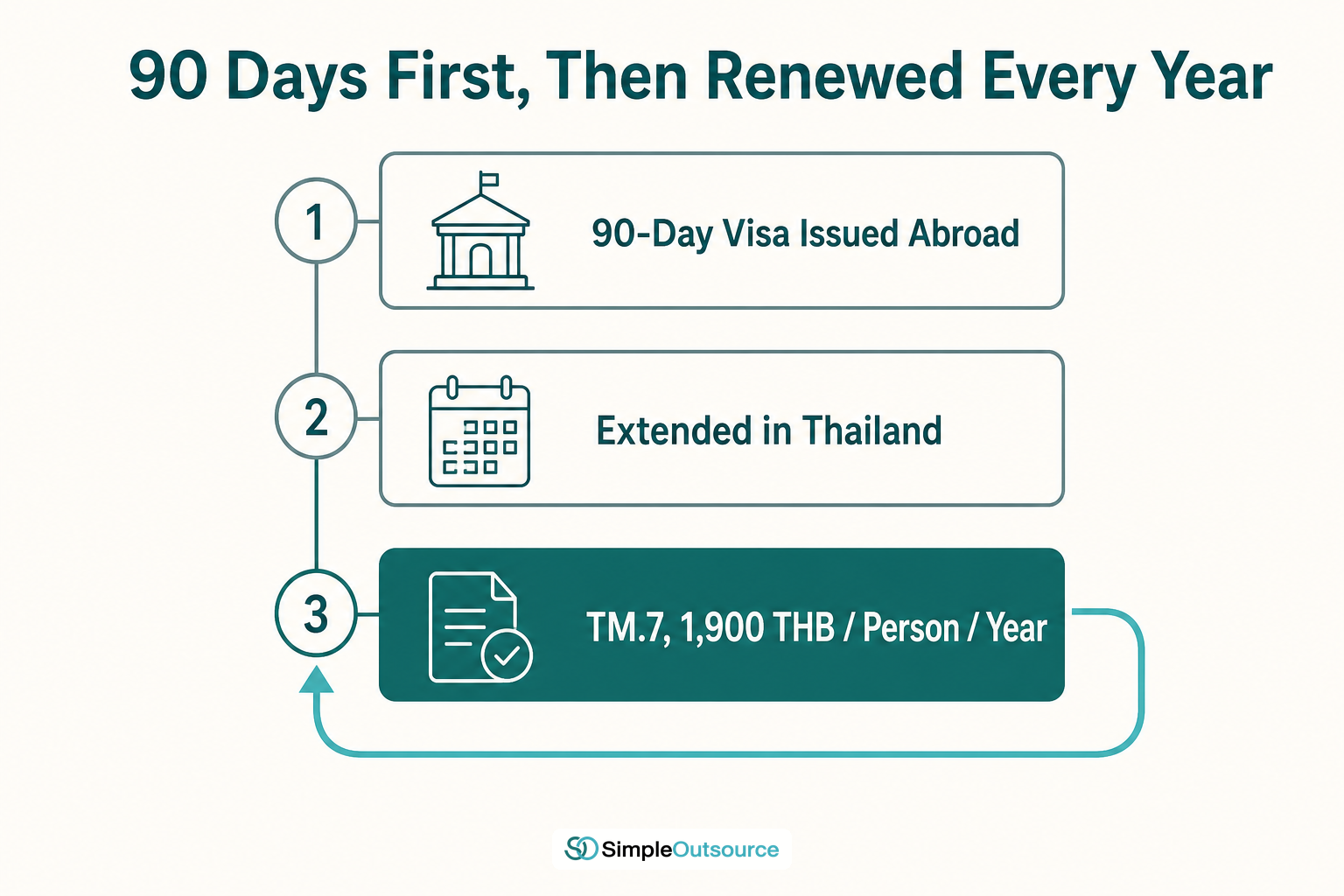
The first dependent visa is issued as a single-entry 90-day visa by a Thai embassy or consulate in the family’s home country (ThaiLawOnline). It is not granted from inside Thailand.
After that, the stay is extended at an immigration office one year at a time using form TM.7, the application for extension of temporary stay, at a fee of 1,900 baht per person per year (Superagent).
Two things follow for an employer. Ninety days is short, and it overlaps with everything else a relocating family is doing — schools, housing, banks. And from then on the family’s renewals run alongside the employee’s own work permit renewal , one file per person, every year. A family of four is four renewals, not one.
A dependent visa is permission to stay, not permission to work

This is the most common misunderstanding, and it is worth being blunt about. A Non-Immigrant O (Dependent) Visa does not permit the holder to work in Thailand. A family member who wants a job needs their own Non-Immigrant B visa and work permit, obtained independently (Royal Thai Embassy, Phnom Penh).
Which leads to a case where our service is the wrong answer. If your employee’s spouse is a professional who intends to work here, filing a dependent visa solves the wrong problem. They need an employer of their own willing to sponsor a permit, and that conversation belongs at the offer stage, not after arrival. Dual-career relocations come apart on this point more often than on salary.
The same applies in reverse. If the family plans to visit for a few weeks at a time rather than live here, a dependent visa may be more administration than the situation calls for.
What to do in the week the work permit is approved
Dependent visas sit inside Simple Outsource’s work permit and visa service, and we prepare the family’s file alongside the primary permit holder’s documents rather than as a separate exercise. That sequencing is the whole trick, and you can run it in-house just as well:
- Confirm who is coming, and check the marriage and the children’s ages against the criteria above before anything else is prepared.
- Tell the family early which civil documents need legalisation at home. That step runs on someone else’s timetable, not yours.
- Issue the employer letter and the work permit copy as soon as the permit is in hand, while the file is still open on someone’s desk.
- Put the family’s renewal dates in the same calendar as the employee’s work permit renewal, on day one.
Your employee will not tell you when their family’s 90 days are running out. They will assume the company is tracking it, because the company tracked everything else. Whoever owns the work permit calendar should own this one too.
If you want a second opinion on a specific assignment, tell us about the case and we will tell you what the family file involves — including if there is no reason to file at all.