



Choosing between a PEO and an EOR in Thailand is mostly a question of one thing: does your company already have a Thai legal entity?
If you do, a PEO can support HR administration while your company remains the employer. If you do not, an EOR can employ a person locally on your behalf while you direct their day-to-day work. The two models can look similar from the employee’s perspective. Behind the scenes, the legal responsibility is different.
That distinction is where costly confusion starts.
Key Takeaways▾
- A PEO is usually the fit when you already have a Thai entity that remains the legal employer.
- An EOR is usually the fit when you need to hire in Thailand without creating your own Thai entity first.
- In both models, your business can manage the employee’s day-to-day work; the difference is who carries the local employer role.
- If you need a Thai entity for commercial operations, that is a separate company-setup decision from choosing employment support.
The short answer: PEO supports your entity; EOR provides the employing entity
A PEO (Professional Employer Organization) is generally suitable when your business already has a registered entity in Thailand and needs help running employment administration. Your company remains the legal employer.
An EOR (Employer of Record) is suitable when you want to hire in Thailand without establishing your own local entity first. The EOR becomes the legal employer, while your business manages the employee’s daily work, priorities, and performance. If the term is new to you, see our fuller explanation of what an Employer of Record is.
This is not a minor contractual detail. It determines who signs the employment contract, runs payroll, administers employment-related obligations, and carries the local employer role.
As Safeguard Global’s Thailand guide explains, an EOR model allows a company to employ workers in Thailand through a local employing partner. Multiplier and Teamed describe the same practical split: the provider handles local employment administration while the client manages the person’s work.
Why “we only need payroll support” can lead to the wrong model
A company may begin with a simple request: “We found a strong candidate in Thailand. Can someone handle payroll and paperwork?”
The answer depends on what is already in place.
If the company has no Thai entity, payroll support alone does not solve the question of who will employ the person locally. A PEO cannot substitute for an entity that does not exist. The company still needs to be able to act as the employer.
If the company already has a Thai entity, the situation changes. It may need operational support, not a new legal employer. That is the territory where a PEO can make sense.
The right starting question is not “Which provider has more services?” It is:
Who needs to be the legal employer in Thailand?
Answer that first. The rest of the decision becomes clearer.
PEO vs EOR in Thailand: the differences that matter
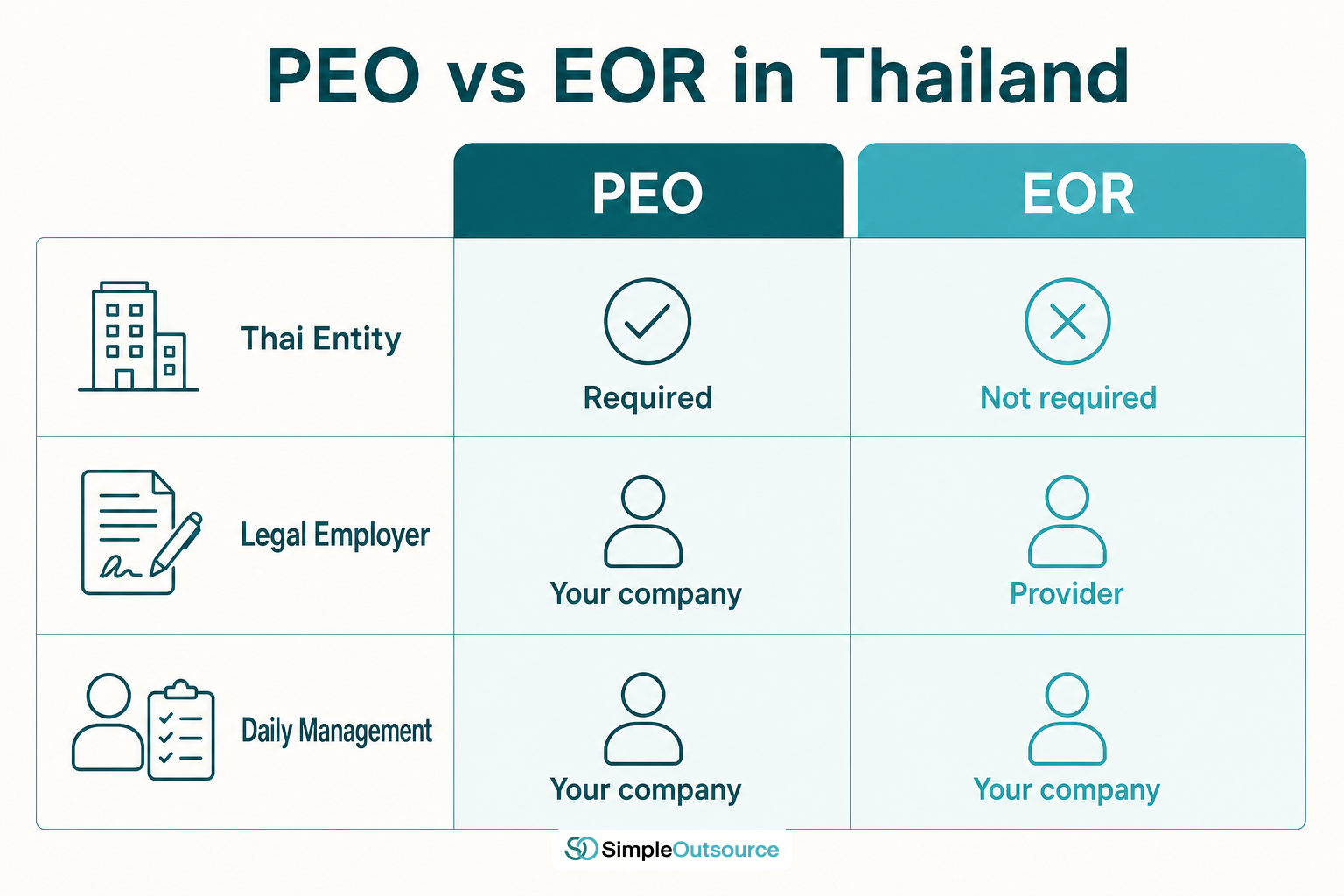
| Decision point | PEO | EOR |
|---|---|---|
| Thai entity | Your company needs its own local entity | Your company can hire without its own Thai entity |
| Legal employer | Your company | The EOR provider |
| Employment contract | Your company is responsible for the employer relationship | The EOR signs as the local legal employer |
| Payroll and administration | The PEO supports your company’s processes | The EOR administers these as employer |
| Daily management | Your company | Your company |
| Best fit | An established Thai entity that wants HR support | A company hiring in Thailand before setting up an entity |
The most important row is often the least visible one: legal employer.
A PEO arrangement does not usually move the employer relationship away from your company. An EOR arrangement does. This is why an EOR is not simply “outsourced payroll,” and a PEO is not simply “a cheaper EOR.”
With an EOR, the legal employer changes—but management does not disappear

One concern companies raise is whether using an EOR means losing control over their hire.
It does not mean that.
With Simple Outsource’s EOR service, we act as the legal employer in Thailand. We handle employment contracts, payroll, tax, social security, and local employment compliance. The client company continues to direct the employee’s daily work: what they work on, who they report to, how performance is managed, and how they collaborate with the wider team.
That division of responsibility is the point of the model.
The EOR carries the local employer administration. The client retains the working relationship that makes the hire useful to the business.
For a fuller view of this model, see our Employer of Record service in Thailand.
A PEO is often the better answer when your Thai entity is already operating
An EOR is not automatically the right recommendation.
If your company already has a functioning Thai entity, can employ staff through that entity, and wants support with the administrative workload around employment, a PEO may be the more appropriate route. The business keeps the legal employer role it already has. The PEO helps organise the operational work around it.
That can be a sensible setup for a company that has committed to a long-term local presence and wants to keep the employment structure inside its own organisation.
In that case, choosing an EOR simply because it sounds more comprehensive may add a layer you do not need.
The model should fit the company’s legal setup—not the other way around.
When EOR is the more practical choice
An EOR tends to fit when the business needs to hire a person in Thailand but is not ready to establish and operate its own Thai entity.
This can apply when a company is testing a new market, building an initial local team, or making a targeted hire without wanting the entity to become the first project. The business still gets a local employee who is embedded in its team. It does not need to make entity formation a prerequisite for that hire.
3P’s overview of Thailand EOR services similarly frames the service around employing workers locally for companies without a local presence.
The important nuance is that EOR removes the need for the client to be the local legal employer. It does not remove the need for good management. A poorly defined role, unclear reporting line, or absent manager stays a management problem under either model.
Three questions to ask before you choose
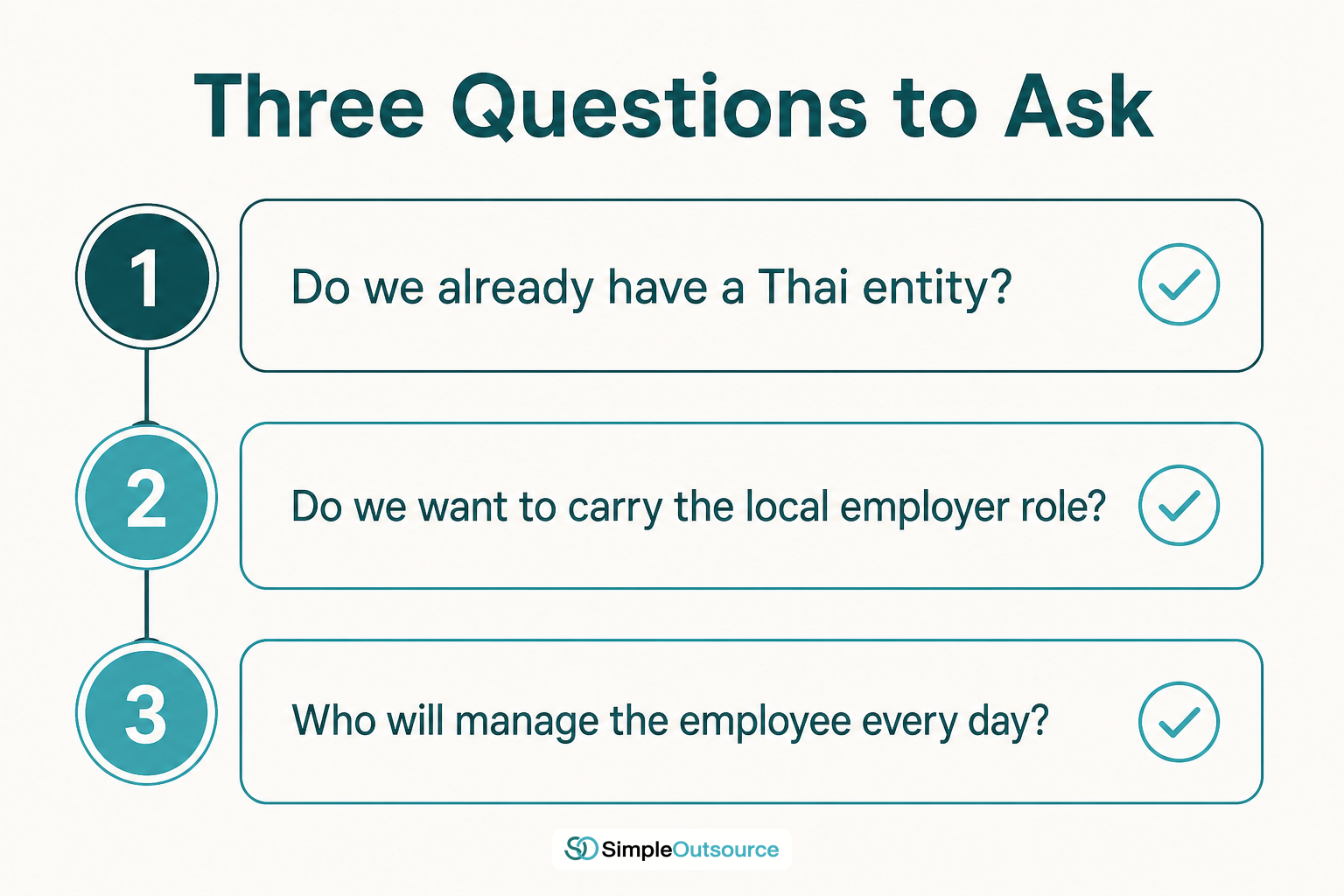
Do we already have a Thai entity that can employ this person?
If the answer is yes, a PEO may be worth evaluating. Your entity can remain the employer while an external partner supports employment administration.
If the answer is no, an EOR is usually the more direct route because it provides the local employing structure.
Do we want to carry the local employer role ourselves?
Some companies want that role because Thailand is a permanent operating base. Others want to focus on the role they are hiring for and leave local employment administration to a specialist.
Neither preference is universally right. It depends on how established the business is locally and how it intends to operate.
Who will manage the employee every day?
The client company should be clear about this regardless of model. The manager, priorities, work systems, performance expectations, and team relationships should come from the business that needs the work done.
The EOR relationship does not turn an employee into a contractor or a detached resource. The person still needs a real place in your operating rhythm.
Do not confuse EOR with entity formation
An EOR can help a company hire before it has a Thai entity. It is not the same as forming one.
If your long-term plan requires your own local company, entity formation may still be the right next step. The question is whether it needs to happen before this hire, or whether an EOR gives you a workable employment path while that broader decision is being made. Our comparison of EOR vs. registering a company in Thailand walks through that decision in more depth.
If you are comparing those routes, our information on setting up a company in Thailand can help you separate the entity decision from the hiring decision.
That separation matters. Businesses often try to solve both at once, then delay a needed hire because every corporate decision has to be settled first.
A practical way to decide

Start with your current legal position.
- You have a Thai entity and want employment administration support: explore a PEO.
- You do not have a Thai entity and need to employ someone in Thailand: explore an EOR.
- You expect to build a permanent Thai operation: consider whether entity formation should sit alongside the hiring plan.
- You are still assessing the market or making an initial hire: an EOR can let the employment decision move without waiting for a full entity decision.
Simple Outsource can act as the local legal employer through our EOR service, while your team manages the employee’s day-to-day work. We handle the contracts, payroll, tax, social security, and compliance that come with the local employer role.
The useful next step is simply to map your existing entity status, the role you want to hire, and who will manage that person. From there, PEO vs EOR is usually no longer an abstract choice.