



This article is written for foreign executives and professional employees (expats) coming to work for a company in Thailand through a direct employer.
A work permit in Thailand is a document issued by the Department of Employment (DOE) that names the position, the occupation or type of work, and the company the permit holder works for (e-WorkPermit, Department of Employment). It is not a licence to do any job anywhere in the country. It is tied to one role and one employer, always. Change jobs or change companies, and you apply again.
Key Takeaways▾
- A work permit in Thailand is a document issued by the Department of Employment that names a specific position, occupation and company — it does not allow the holder to work anywhere else.
- A visa and a work permit are two different things. The visa is your right to be in Thailand; the work permit is your right to work here. You need both to work legally.
- The standard route for an applicant coming from overseas is to obtain a Non-Immigrant B visa at a Thai embassy, enter Thailand, then file the work permit application with the Department of Employment in the area where the workplace is located.
- A new application is filed under Section 59 (Form บต.25) and a renewal under Section 67 (also Form บต.25). They are separate processes, not one form reused.
The Right to Stay and the Right to Work Are Two Different Things
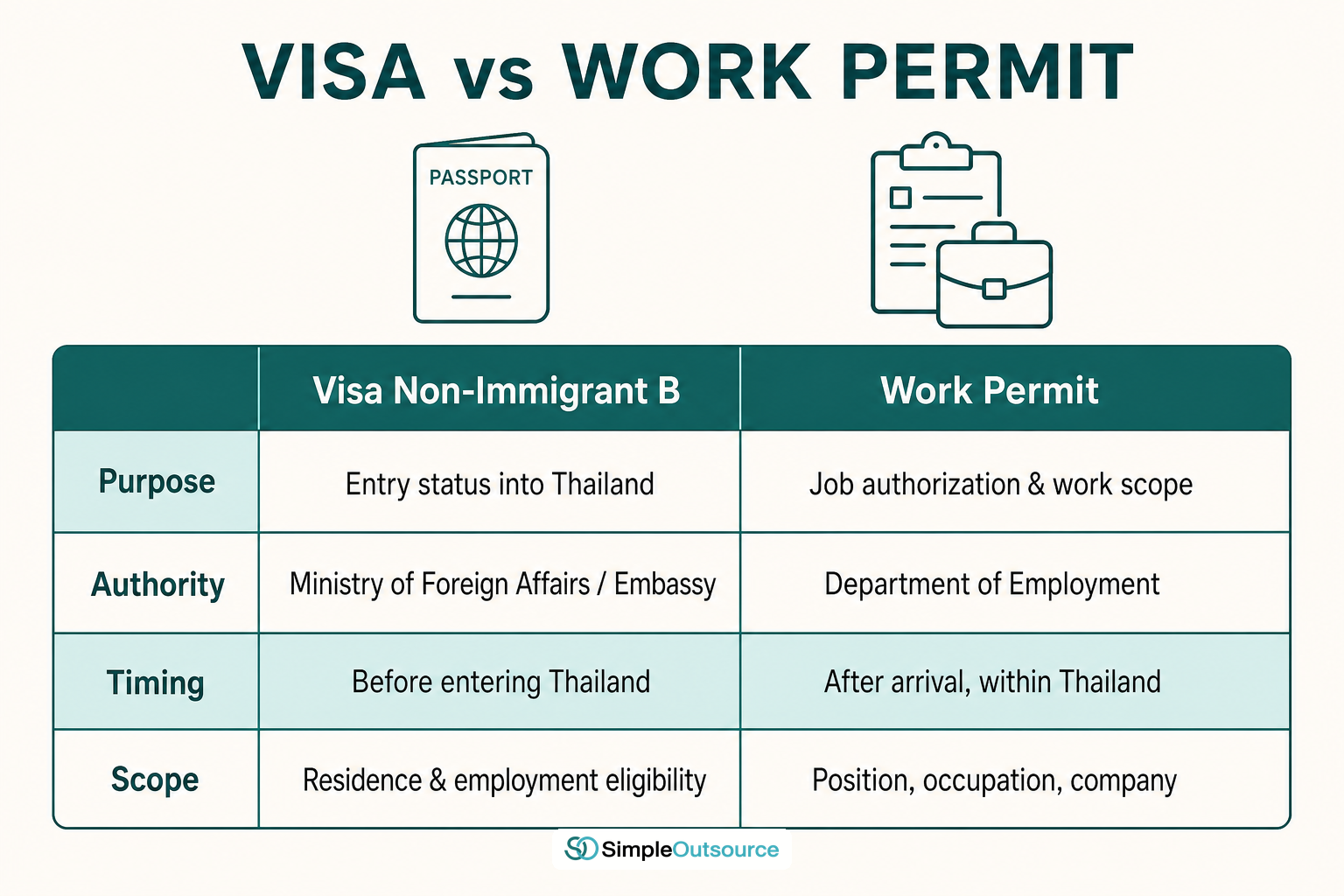
A visa and a work permit answer different questions. A Non-Immigrant B visa answers “are you allowed to be in Thailand?” A work permit answers “are you allowed to work in Thailand?” The two are completely separate. Holding a visa and starting work without a permit means working illegally, even though your presence in the country is perfectly legal.
You need both. It isn’t a choice between them.
| Dimension | Visa (Non-Immigrant B) | Work permit |
|---|---|---|
| Answers the question | Can you stay in Thailand? | Can you work in Thailand? |
| Issued by | Royal Thai Embassy or Consulate abroad | Department of Employment |
| Tied to | The individual and the purpose of entry | The position, occupation or type of work, and the employing company |
| Needed to work? | Yes, but not sufficient on its own | Yes — a visa alone does not allow you to work |
If you want to see how the Non-Immigrant B visa and the work permit fit together step by step in practice, we cover the full sequence in how to get a work permit in Thailand .
Who Needs a Work Permit in Thailand?
Any foreign national who is going to work in Thailand needs a work permit before starting work — whether the role is an executive position, a specialist role, or a regular full-time job at a company registered in Thailand. And because the permit names a specific position and a specific company, anyone who changes jobs or changes employers while already in Thailand has to file again too. It isn’t only a first-arrival requirement.
BOI-promoted projects follow a separate filing route; you can read about that route in work permits for BOI-promoted projects .
The Standard Route for Expats Applying from Overseas
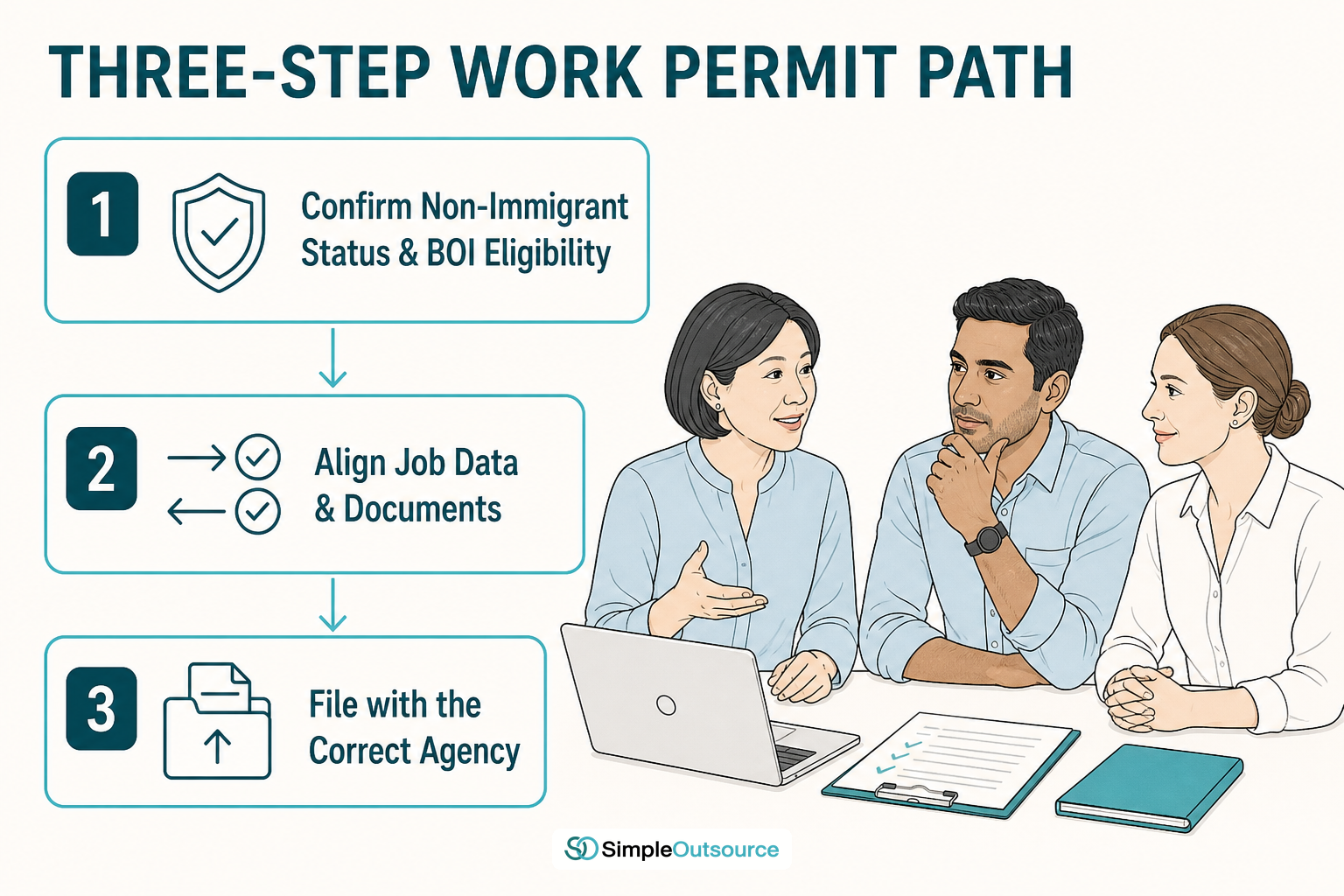
For someone who has not yet entered Thailand, the standard sequence set out by the Department of Employment is: apply for a Non-Immigrant B visa at the Royal Thai Embassy in your home country, enter Thailand, then file the work permit application with the Department of Employment in the area where the workplace is located — not the area where you live (Frequently Asked Questions, Department of Employment).
That order can’t be rearranged. You cannot file for a work permit before you hold a Non-Immigrant B visa, and you cannot start working before the permit is issued. Once the documents are complete, a decision generally follows within 7 working days according to the Department of Employment. Treat that as the timeframe that applies when the file is complete, not a guarantee for every case.
A New Application and a Renewal Sit Under Different Sections of the Law

A first work permit application and a renewal are not the same process. According to the Department of Employment, they rest on different sections of the law. A new application for someone working on the basis of knowledge or skills is filed under Section 59 (Form บต.25), while a renewal is filed under Section 67 (the same Form บต.25 as far as the form goes, but a different legal provision) (e-WorkPermit, Department of Employment).
| Type | Legal basis | Form | When it applies |
|---|---|---|---|
| New application (work based on knowledge/skills) | Section 59 | บต.25 | No work permit held yet, or a change of position/company |
| Renewal (work based on knowledge/skills) | Section 67 | บต.25 | Existing permit still valid and approaching expiry |
Companies with several foreign employees should track expiry dates person by person.
What the Employer Has to Do Before a Foreign Hire Can Start

Employers usually ask what falls on them. First, the company itself has to meet the conditions the Department of Employment sets for hiring foreign staff. Then it has to put together the employer-side documents for the employee’s work permit application, in parallel with the employee preparing their own set.
From the work we do at Simple Outsource managing this process for clients, the step that pays for itself most is reviewing both document sets — the employer’s and the employee’s — before the application goes in, rather than filing first and fixing afterwards. Correcting documents while a decision is pending always takes longer than getting them right at the start. That is what makes the 7-working-day timeframe mean something in practice, instead of being a number on an official page.
What to Do Next
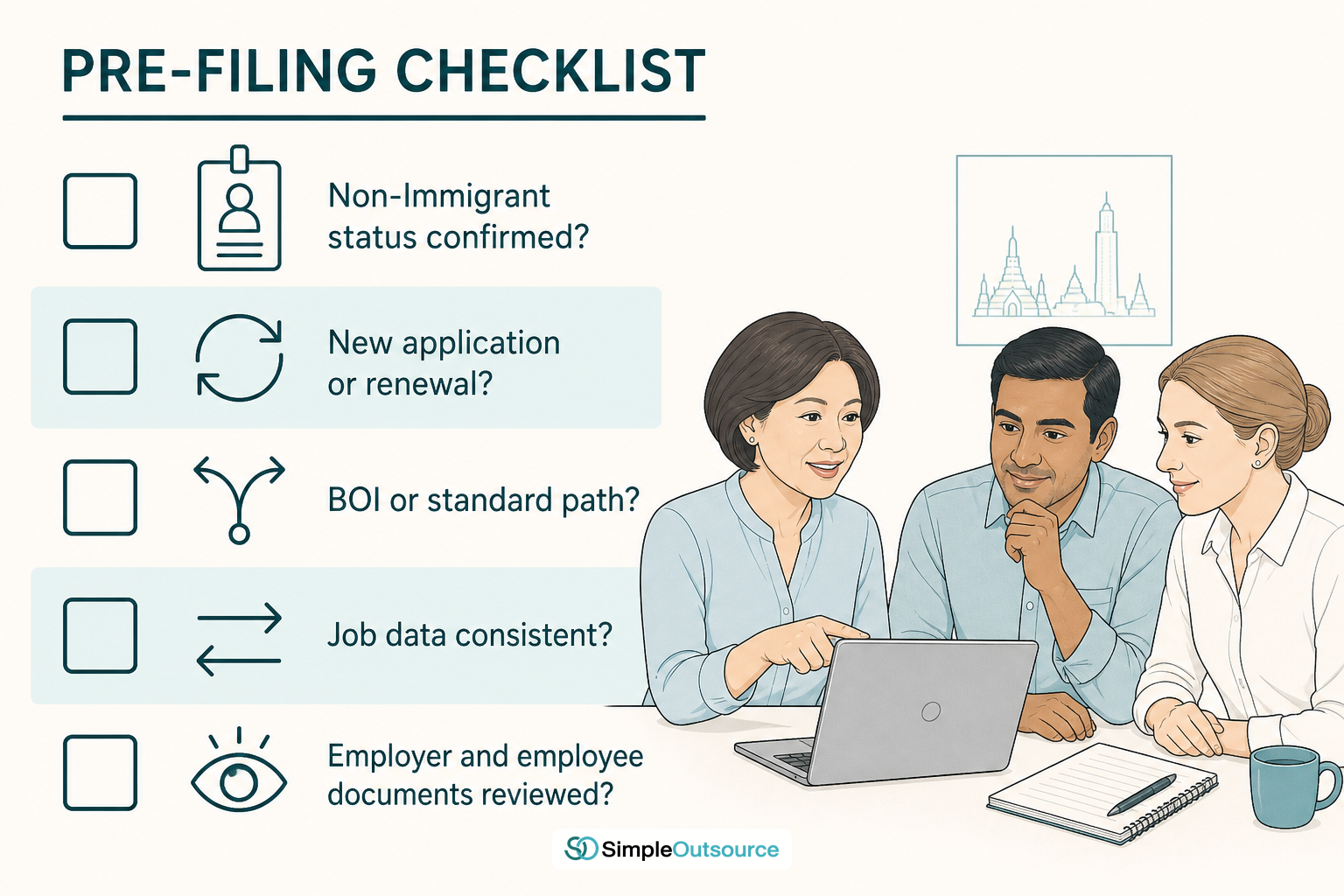
If you’re an expat about to relocate to Thailand, or a company preparing to hire a foreign employee, start by getting the sequence right — Non-Immigrant B visa first, then work permit — and by having both the employer’s and the employee’s documents complete before you file.
Simple Outsource reviews both document sets before the application goes in and handles the visa and work permit process end to end. If you’d like our team to check how ready your company is before you start, take a look at our visa and work permit service. There’s no obligation — you can talk it through with us before deciding anything.
Frequently Asked Questions
How is a work permit different from a work visa?
A Non-Immigrant B visa is your right to be in Thailand legally; a work permit is your right to work here legally. They are issued by different authorities — the embassy and the Department of Employment — and you need both at the same time to work lawfully. Holding a visa and starting work without a permit counts as working illegally, even though you are in the country legally.
Where do you file a work permit application, and how long does it take?
You file with the Department of Employment in the area where the workplace is located, not where you live. Once the documents are complete, a decision generally follows within 7 working days according to the Department of Employment. That timeframe assumes a complete file; it is not a guarantee for every case.
Can I keep my existing work permit if I change jobs or employers?
No. A work permit names the position, the occupation or type of work, and the company of the permit holder. Anyone who changes jobs or changes employers while in Thailand has to file a new application — it isn’t only first-time arrivals who need to apply.
Is renewing a work permit the same as filing a completely new application?
No. A renewal is filed under Section 67 (Form บต.25), a different section of the law from a new application, which is filed under Section 59. The form is the same บต.25 in both cases, but they are two separate legal processes.